
By Ashoka Vardhan Manchala
On 15th October 1877, in the princely state of Hyderabad in today’s India, the powerful landlord Muthukristna Moodelliar received a royal decree written in Farsi, a “sanad”. The document, that specified which rights the landlord held in his territory, would later become part of a legal dispute between the same landlord and the Nizam, the Muslim ruler of the state of Hyderabad.
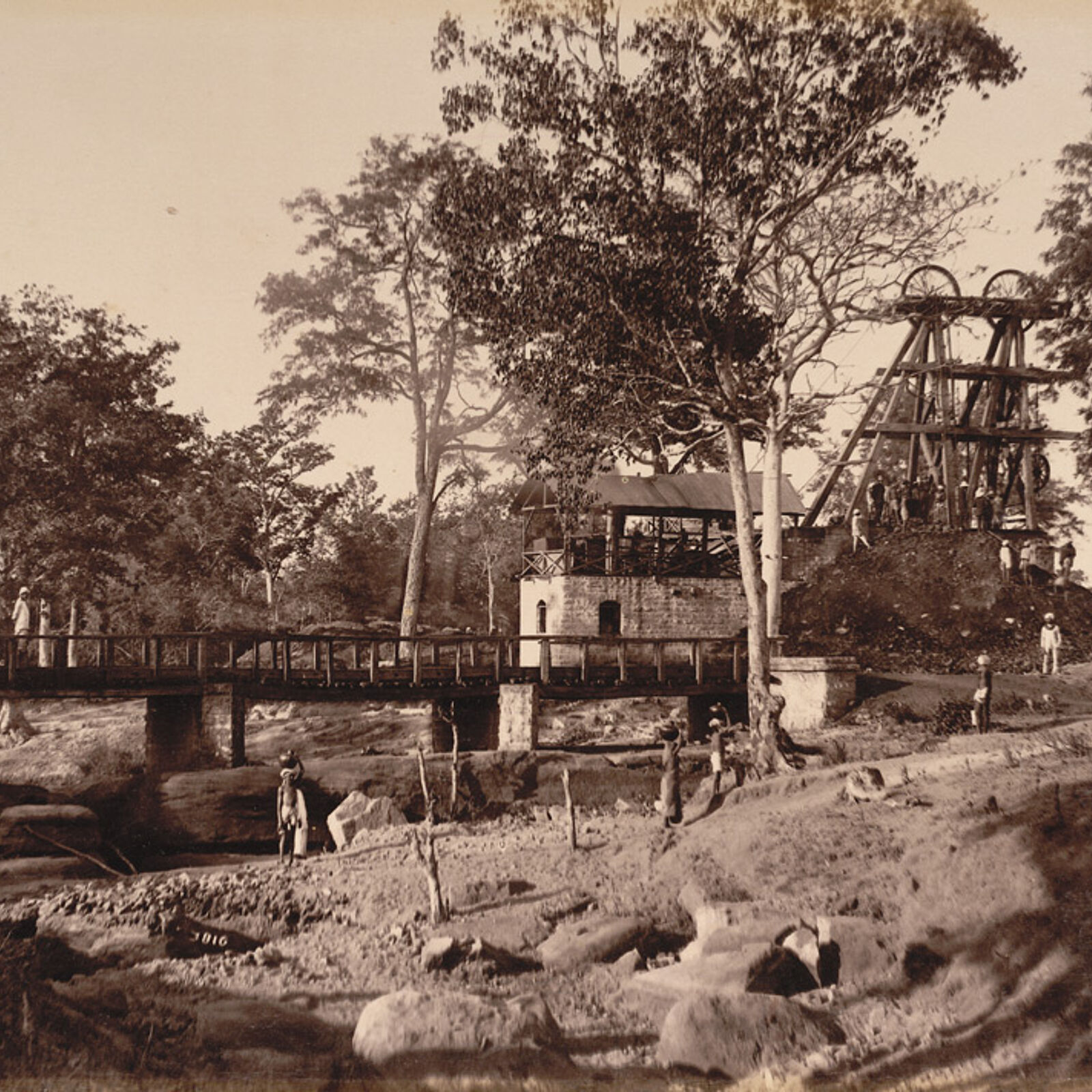
At that time, the complex system of landownership in Hyderabad faced a new challenge: coal mining. Coal had just recently been discovered, and new mines were successively being opened. Coal mining was also the plan of landlord Moodelliar, whose estate lay in the region of Ramanjaveram and Mulloor, at the eastern border of the Hyderabad state: In the early 1890s, he granted mining leases to two British companies, Godavari Estates Limited and Godavari Valley Collieries Limited.
But the Nizam and his government had other plans: The Nizam’s government already leased out the entirety of mining rights of the territory where the landlord resided to another British company called the Hyderabad (Deccan) Mining Company, which was already operating.
All these leases could not exist at the same time. So, a legal dispute evolved around the question, whose right it was to exploit the recently discovered coal. The landlord’s solicitor argued that Moodelliar had mining rights over his land, while the government argued that the Nizam, as the ultimate sovereign of Hyderabad, held the ultimate rights.
This story sheds light on the various dynamics around land ownership and the diverse landholding practices in South Asia that persist to this day. It also challenges common perceptions of Indian culture and land ownership. Some narratives in India and the West are based on the idea that India had first experienced a “just” and “golden” Hindu rule, that was succeeded by “Muslim Mughals” and “British Christians”. According to this narrative, the Shia governor of Hyderabad was a powerful ruler over a predominantly Hindu population. This reading was initially popular among early modern British historians who were associated with Orientalism and has resurfaced in various formats to this day.
This reading is simplistic also because it fails to acknowledge the complex power dynamics between the apparent ruler and the ruled, which were far more diverse than the narrative above suggests. It obscures the strict hierarchies that defined and still define South Asian society and ignores the significant power held by landowners in the complex feudal system of the princely state of Hyderabad at that time. Because land represented much more than just ground or earth. It had many meanings in legal, political and economic contexts, each of which had a real-world impact. The link between power over land and social power formed the core of it: Class, caste, gender, region and several other social markers were necessary conditions for owning land.
Of course, rulers were more powerful in some contexts, but landlords were not powerless. On the contrary: Within their often-extensive territories, they ruled local economies, held policing powers and collected revenue and even owned the bodies and labour of some people. They were de facto local rulers, especially since the state ruler, the Nizam, often lived far away, as for example in the city of Hyderabad, located 300 kilometres from Ramanjaveram, the aforementioned region.
The prince and landlords in Hyderabad
Hyderabad State was the largest and the most powerful of the princely states in South Asia. In 1900, it covered an area of 82,698 square miles (for comparison, Switzerland today covers around 15,000 square miles), and had a population of eleven million, making it the most populous state. Its capital, also called Hyderabad, was and still is one of India’s largest cities. Agriculture was the main source of revenue, and coal eventually became the most important industry. Telugu, Farsi (later replaced by Urdu), Kannada and Marathi, were the official languages, as well as others such as Lambada and Koya.
It was impossible for one ruler to have direct control over such a vast and diverse population. This is where landlords came in. The confusion about individual rule stems from the term “princes”, which theoretically referred to the rulers of these states. But this was only true of the smallest states, the term over-simplified their complex status in the British Indian legal system. This is why New York based historian Eric Beverley refers to them as “minor states” instead.
At the time the dispute between our landlord and the Nizam of Hyderabad occurred, there existed more than 560 princely states, covering 40 per cent of the area of modern-day India, Pakistan and Bangladesh. The remaining 60 per cent were under the control of British Indian Provinces. This is why Lauren Benton, a historian at Yale University, called the British Indian map a “carpet full of holes”. The princely states were technically considered foreign entities and were contacted through the Foreign Department.
The princely states had their own local laws, policing and revenue systems and, sometimes, even their own currencies. Still, of course, the British exercised a lot of influence: They collected revenues, controlled armies and external affairs. At the same time, many internal powers were left to the princely administrations. They had spheres of autonomy such as internal law and policing, which in the case of Hyderabad was exercised till 1948, one year after the foundation of the modern state of India. These “minor ” or “semi-sovereign” states were neither fully independent nor fully colonized. Legally speaking, they were “in-between” states, resembling American-Indian reservations or Specially Administered Territories and mandates.
Oversimplification also occurs in the religious sphere. The aristocracy of Hyderabad was Shi'a and belonged to the Asaf Jahi dynasty. Their hereditary ruler was the Nizam, what literally means “governor”, as Hyderabad was a governorate under the Mughal Empire, whose aristocracy was Sunni. Shi'a and Sunni, however, were just two of several kinds of Islamic sects with specific schools in South Asia, similar to the numerous religious sects of Buddhism and Jainism, which have existed since 500 BCE. The Islamic sects, which started to emerge in the 13th century, have been marked by various regional, cultural, and linguistic variations. Most of them also adopted the existing social stratification, that was usually based on land ownership, which gave landowners with different religious backgrounds a form of social equivalence.
The power of the landlords
In the Hyderabad State the ruler often acted as a landlord to the landlords. The local landlords, however, would sometimes use their power to negotiate with the ruler above them - for example, by granting coal mining rights. And – landlords had many titles. One of these was the title of “Zamindar”: a Persian word derived from “zamin”, land, and “dar”, holder. But this was not the only official title for landlords. Sometimes a single person could hold more than one title that referred to different revenue systems; each title referred to a different property system. There were thousands of these titles in British India and neighbouring states. They were constantly negotiated between the elites, and their meanings changed over time.
The power of a Zamindar like Moodelliar can be seen in at least three ways. The first was wealth. For example, in his legal dispute with the Nizam, Moodelliar could afford to hire British lawyers to represent him on an equal footing with the ruler.
Secondly, the landowning families lent money to the aristocratic families in the capital city. In our case records, we find instances where the Nizam’s government granted land to the Moodelliar family in return for loans to the Nizam family. These rights were granted as part of the repayment. This is interesting, especially given that the Nizam's aristocracy was recognised as one of the wealthiest in the world. In 1937, “Time Magazine” titled the Nizam Mir Osman Ali Khan the World’s Richest Man.
The third dimension is the most powerful yet least explicit aspect of historical records. In the history of the Hyderabad State, landlords exercised a particularly dire and notorious control over the local population, even compared to other landownership systems. Proof of this can be seen in the anti-landlord rebellion that broke out in the Hyderabad State thirty years after the aforementioned legal dispute. This rebellion, known as the “Telangana Rebellion”, was one of the largest and bloodiest civil wars and rebellions led by landless labourers, peasants and indigenous peoples in the region. According to Margrit Pernau, a historian at the Max Planck Institute for Human Development in Berlin, it was the largest peasant revolution in post-World War II Asia after the Chinese Revolution.
Such uprisings against landlords expressed deep resentment of existing social structures. Many social groups were enslaved under the “vetti” system, a prevalent form of slavery, which was specific to Hyderabad and directly correlated with social hierarchies. Zamindars ruled over land, people, resources and labour through economic and social power. In other words, landlords' rights to property were not sanctioned by a free market, but by social power within an immutable social hierarchy.
Consequently, not everyone had access to land ownership or the law. Due to the restrictions of social mobility most people were landless agricultural labourers, while the privilege of large landownership was reserved for those at the top of the social hierarchy in British India and the adjoining states.
Indeed, many of the most famous historical figures from South Asia originated from families with large estates. Even if they were not owners of large estates, others still accessed extraordinary political and economic privileges alongside land ownership. Mohandas Gandhi, for example, came from a family of moneylenders and was the son of the most powerful minister in the princely state of Porbandar. These privileges enabled Gandhi to pursue his higher education in law in London and establish a career as a lawyer in South Africa.
The importance of social power is reflected in the writings of figures such as Gandhi, who mentions his caste in the opening line of his autobiography. Apart from this most famous example, many academics and novelists still have family names that indicate access to land power. Ironically, even among communist leaders and thinkers in South Asian or of South Asian descent, many continue to be landowners with the same privileges, which are often not acknowledged. The context of social hierarchies tends not to be explicit in historical documents such as the one cited above.
Maneuvering between the Nizam and the British
In the legal dispute presented at the beginning of this text, a document referred to as the “sanad”, a royal decree confirming certain rights over lands and territories, was issued to the landlord Moodelliar by the Nizam of Hyderabad.
Interestingly, it was not only the British government that issued sanads to princely states; the states themselves also issued sanads to landlords. After all, the Hyderabad State was a breakaway province of the Mughal Empire with its own multiple layers of revenue collection. Sanads therefore demonstrated how power was divided between unequal yet powerful political elites.
However, law lives much beyond paper. In the context of land-based power, practice differed from law in two ways: The political status of each princely state depended on the politics of the time and on what laws were being used as tools in legal and political matters. In this case, the language of property rights was used. It was this malleable nature of law that gave power to both the more and less powerful parties, a process that Priyasha Saksena, a legal historian at the University of Leeds, termed “jousting over jurisdiction”.
“Customary law” is another aspect that is missing from the law on paper. For example, the sanad granted several rights to the landlord. These included various dues that the landlord would receive from his subjects, including a “rusoom” or a “peshkash”, taxes on various goods. However, beyond this, it recognised existing social hierarchies, which were codified into law in the name of custom. This was also written into the three property systems introduced by the British across the British Indian provinces. These systems were based on historical precedents in the respective Mughal provinces.
The Permanent Settlement System and the Zamindari system collected revenue directly from the zamindar; the Ryotwari system collected it from landowning peasants with smaller plots; and the Mahalwari system collected it from village units. In the latter system, however, the village unit only referred to existing groups of powerful landed villagers, while all other groups were excluded. This was part of the legal jurisprudence of late imperial liberalism, which shaped the British perspective on land ownership. Therefore, the rights of the landlord listed in the sanad were only part of a larger set of customary laws drawn from social power.
The Nizam wins
As the sanad had been produced by the Nizam’s government, the British authorities, that had been mediating the dispute until then, left the matter to the Nizam’s government. It was quite common in British imperial structures of that time for the involvement of British governments to suddenly dwindle when their interests were no longer significant.
So, the dispute ended with the Nizam’s government deciding that the sanad did not grant the Zamindar any mining rights, and that the lease he gave to the two coal companies was null and void. Despite their efforts, the landlord's solicitors now had no choice but to accept the change in their client's position in the legal dispute, from party to subject. This shift from the legal to the political was indicative of the fact that legal systems are part of political contexts which determine how law functions.
Here, the story could end. But the ability of the Hyderabad government to deny such a right contains another element: The confusion about land rights was a relatively recent phenomenon for many political and legal systems, arising from the emergence of extractive and mining industries. Land rights were often considered to apply only to the surface of the land. However, when commercially lucrative coal and other minerals were discovered, the matter of underground rights suddenly presented a new challenge: the land became three-dimensional. Surface land rights did not automatically guarantee rights underground. This resulted in many separate systems and practices.
In Hyderabad the access that landlords had to private property and law, gave them an advantage over others living on the land, including those in vetti slavery, and groups from the lowest parts of the social hierarchy. In the British province of Bengal, coal rights were also the subject of long-running legal disputes, in which Zamindars tried their best to categorise underground coal as their own. In contrast, in Nagaland, which borders today's Myanmar, coal rights were based on households. Here, coal belongs to the household on whose land it is found, resulting in household-written contracts with others, also with people from outside Nagaland.
Research on this topic is lacking in Hyderabad. As this legal dispute proves, the battle was also fought within and around the law. In this case, the Nizam’s government claimed rights, which was the result of a long history of confusion and lack of definition of such rights. The three-dimensional nature of the land certainly brings the legal aspect to the fore and shows that the elephant in the room between fossil fuels, law and business is indeed land ownership. Contesting such land rights raises questions about the distribution of power in society and how elites compete for resources.
However, historical archives tend to focus on the actions of the elite while experiences of non-elites are often overlooked. The document only tells the story of how two powerful yet unequal people fought it out in the legal arena. It tells us nothing about who worked on the land and in the mines. Therefore, a history of fossil fuel businesses is necessarily a history of competing definitions of land ownership, and consequently, social power. The legal dispute with which we began also makes this complexity visible.
Issues of land ownership and legal harmonisation continued to plague the newly independent nations after the British left. After a protracted civil war, Hyderabad became part of India, and eight years later it was officially dissolved and merged into neighbouring states, which were former British provinces. Several political actors recognised that land ownership and dispossession were linked. Some of them organised a tour to encourage land donations, known as the Bhoodan Movement, but this resulted in only minor changes. In regions such as Telangana, the countless layers and varieties of land ownership categories continued to exist for a long time. The link to social power and land ownership is key to understanding such histories.
Ashoka Vardhan Manchala is a researcher of History of Energy at the University of Zurich in Switzerland. His doctoral thesis explores the interaction between energy and social inequalities at a regional level. It sheds light on many paradoxes surrounding energy transitions, particularly the manner in which coal has generated social and political value for numerous groups over the past century.
Further Readings:
- Benton, Lauren. A Search for Sovereignty: Law and Geography in European Empires, 1400–1900. Cambridge University Press, 2009.
- Beverley, Eric Lewis. “Territoriality in Motion: Waqf and Hyderabad State”. The Muslim World 108, no. 4 (October 2018): 630–51.
- Beverley, Eric Lewis. Hyderabad, British India, and the World: Muslim Networks and Minor Sovereignty, c. 1850–1950. Cambridge: Cambridge University Press, 2015.
- Khusro, A. M. Economic and Social Effects of Jagirdari Abolition and Land Reforms in Hyderabad. Hyderabad: Department of Publications and University Press, Osmania University, 1958.
- Mantena, Karuna. Alibis of Empire: Henry Maine and the Ends of Liberal Imperialism. Princeton University Press, 2010.
- Metcalf, Barbara D., ed. Islam in South Asia in Practice. Princeton, NJ: Princeton University Press, 2009.
- Pernau, Margrit. The Passing of Patrimonialism: Politics and Political Culture in Hyderabad 1911- 1948. New Delhi: Manohar, 2000.
- Saksena, Priyasha. Sovereignty, International Law, and the Princely States of Colonial South Asia. 1st ed. Oxford University Press: Oxford, 2023.
- Wahi, Namita. “The Fundamental Right to Property in the Indian Constitution”. SRRN. (August 10, 2015): 1-35.