Islams minoritaires (shi’ismes et ibadisme) Modes de coexistence et d’organisation communautaire
International Symposium
Lausanne, Université de Lausanne (Unil), June 12-14, 2025
Too often regarded as peripheral, Shi’ite and Ibadi Islams, through their alternative interpretations of
Islamic traditions, shed light on the mechanisms underlying the establishment of the hegemonic Sunni
model. The research project "Building Society" offers an unprecedented comparison between the
theological and legal doctrines of these currents which, though now considered minorities,
significantly shaped Islam during the medieval period. The study combines the methods of Islamic
studies with a socio-political historical approach. Its aim is to explore the political and religious thought
of these traditions, as well as their social and institutional models. Furthermore, it seeks to analyze
the theoretical and practical solutions developed in minority contexts to address the necessity of
coexisting with external powers and populations – often hostile to the community.
As part of the "Building Society" research project, the first international symposium (Lyon, November
28–29, 2024) addressed the question of the ideal model of the imamate as well as the actual practices
of governance in minority Islams, focusing on the cases of Shi’ism and Ibadism. The second
international symposium (Lausanne, June 12–14, 2025) will explore the strategies developed by Shi’ite
and Ibadi religious minorities to ensure their communities' coexistence with neighboring Islamic
groups, particularly the ruling Sunni majority. The symposium will also examine the organization of
these Shi’ite and Ibadi minorities, their religious and legal institutions, and their efforts to develop a
communal project of social cohesion (intra-community) and social distinction (external).
The contributions to the Lausanne symposium (June 12–14, 2025) will fall under one of the following
two themes:
1) Analyze how Shi’ite and Ibadi minority groups construct their social model both in collaboration
with and in opposition to the majority. The study focuses on: [i] the group’s institutional
developments to justify or reject its submission to central authority; [ii] the accommodations
proposed by the ulema; [iii] the doctrinal and legal convergences and divergences with the
dominant culture.
2) Study the alternative models of society developed within Shi’ite and Ibadi communities to: [i]
ensure internal group cohesion (doctrinal, clannish, political, legal); [ii] distinguish the community
from the ruling Sunni majority or other neighboring competing communities.
All contributions from the Lausanne and Lyon symposiums, in both French and English, will be brought
together in a single volume. The publication is planned as part of the Bibliothèque de l’Institut français
d’Islamologie series, with Éditions du Cerf (Paris).
The organizer of the Lausanne symposium, Wissam Halawi (University of Lausanne), on behalf of the
"Building Society" project team: Cyrille Aillet and Enki Baptiste (Université Lyon 2, CIHAM), Ersilia
Francesca (Università degli Studi di Napoli “L'Orientale”), Adam Gaiser (Florida State University),
Robert Gleave (University of Exeter), Bruno Paoli (Université Lyon 2).
Centers and Peripheries in Japan
University of Zurich, June 2-3, 2025, Room RAA G15 (Rämistrasse 59, 8006 Zürich)
Today, Japan is a highly centralized nation state, and it has projected this character onto its past. Its official history is fundamentally determined by its political centers; their names became the terms for historical periods, providing the chronological grid that organizes our knowledge of the country’s history. During the process of modernization and nation building, this retrospective vision allowed the implicit construction of a so-called “homogenous” territory that was structured according to the hierarchy between a center and peripheries. After 1945, with the loss of the colonies—characteristically referred to as the “outer territories” (gaichi) of the Japanese empire—this cultural homogenization and political hierarchization into center and periphery was further reinforced.
In principle, this simplistic view has long been challenged and is no longer considered valid in academic research. However, its legacy continues, not least because of the body of narratives, literature and canonical sources that was created in accordance with it. There is therefore still much work to be done to create a more multicentered view of Japan. We can start from reflecting on the mere definition of what is or was a center, and what is or was a periphery, whether in Japan today or in any previous period in history. Further questions involve the re-thinking of canons and corpora in all areas of research. Reflecting on the boundaries and dimensions that shaped the mono-centric, homogeneous view, multi-scalar and transdisciplinary analysis can help to foreground the fluidity of the concepts in question as well as the conflicts, tensions and negotiations between Japan’s multiple centers and their peripheries. Additionally, exploring how political, social, or literary groups aim/ed to maintain their central position while peripheral groups endeavor/ed to gain access to the center, perhaps through subversive methods as described by Bourdieu, can contribute to our understanding of the power dynamics within Japan’s different spheres of influence.
The aim of this conference is to create a dialogue between different approaches to this topic from numerous fields (linguistics, literature, history, geography, political sciences, sociology, ethnology, etc.), and multifarious angles (normativity, censure, constraint, freedom, symbolic hierarchy, identity-related negotiation, etc.). Papers presented are eligible (upon peer-review) for publication in a theme issue of the open access journal Asiatische Studien / Études asiatiques, published by the Swiss Asia Society with De Gruyter.
Organization committee
-
Prof. Dr. Claire-Akiko Brisset (University of Geneva)
-
Prof. Dr. David Chiavacci (University of Zurich)
-
Prof. Dr. Ewa Machotka (University of Zurich)
-
Prof. Dr. Simone Müller (University of Zurich)
-
Prof. Dr. Raji Steineck (University of Zurich)
Monday, June 2
9:00-9:30 Welcome and Opening
- Prof. Dr. Raji Steineck (Vice Dean Research of Faculty of Arts and Social Sciences, University of Zurich, Switzerland)
- Prof. Dr. Nicolas Martin (Director of the Institute of Asian and Oriental Studies, University of Zurich, Switzerland)
- Prof. Dr. Simone Müller (President, Swiss Asia Society, Switzerland)
10:00-12:00 (Re)Constructing and Inventing Identities
- Prof. Dr. Mária Ildikó Farkas (Károli Gáspár University of the Reformed Church, Hungary): “Japanese Folk Culture: From Peripheries to the Centre of Cultural Identity”
- Prof. Dr. Fynn Holm (University of Tübingen, Germany): “Change and Continuity in the Periphery: Suzuki Bokushi and the Transmission of History in the Akiyama Mountain Community
- Dr. Chiara Rita Napolitano (Postdoc, Kyoto University, Japan): “Periphery or Cultural Heart? Kyoto’s Role in Shaping the ‘Authentically Japanese’ Experience”
12:00-13:30 Lunch break
13:30-15:30 Rethinking Historical Orders
- Dr. Tsui Shuen Lau (Postdoc, University of Tübingen, Germany): “The Fluidity of Prestige: Nikkō and the Negotiation of Center and Periphery, 1870s-1940s”
- Melanie Müller (PhD candidate, University of Zurich, Switzerland): “Challenging the Center: Peripheral Power in the Sengoku Period”
- Anna Nielsen (PhD candidate, University of California Berkeley, USA): “Horses, Tack and Technological Innovation: Northern Kyushu as a Peripheral Core in Japan’s Kofun Period”
15:30-16:00 Coffee break
16:00-18:00 Young Research Workshop (Panel Discussion): “Academic Career Paths in Asian Studies: Commonalities and Differences in Asia, Europe, and North America”
18:00-20:30 Apéro
Tuesday, June 3
10:00-12:00 Colonial and Transnational Connections and Tensions
- Prof. Dr. Caitlin Karyadi (University of Hong Kong, China): “Intimate Circuits: Shen Nanpin, Chinese Painting, and Japanese Art History”
- Patricia Lenz (PhD candidate, University of Zurich, Switzerland): “Addressing Quasi-Colonial Exploitation of Peripheral Regions in the Art of Shiga Lieko and Yamashiro Chikako”
- Scott Ma (PhD candidate, University of Zurich, Switzerland): “Science and Authority through the Eyes of a Mid-Ranking Bureaucrat in Japanese Taiwan”
12:00-13:00 Lunch break
13:00-15:00 Negotiation Processes in Cultural History
- Ryan Hintzman (PhD candidate, Yale University, USA): “Scribbles, Sighs, and Supplication: Notes on Poetic Countertraditions in Japan, 900-1477”
- Berfu Sengun (PhD candidate, University of Zurich): “Narrative Centers and Peripheries: Reimagining Space and Identity in The Tale of Genji”
- Maria Slautina (PhD candidate, Princeton University, USA): “Remapping Tea: Centers and Peripheries in the Early Edo Chanoyu”
15:00-15:30 Coffee break
15:30-17:30 Tensions between Center and Periphery in Literature
- Laura Agnel (PhD candidate, French School of the Far East, France): “Du centre aux provinces reculées du nord du Japon: le cas de Sugae Masumi, un voyageur lettré du 19ème siècle”
- Maria Carbune (PhD candidate, Ruprecht-Karls-University Heidelberg, Germany): “From the Periphery to the Centre: The Socio-cultural Role of the Akutagawa Prize and the Instrumentalization of Modern Japanese Literature”
- Prof. Dr. Veronica De Pieri (University of Bologna, Italy): “Transgenerational Trauma in Yū Miri’s The End of August (2023): A Cross-Culture Psychological Perspective”
17:30-18:00 Concluding remarks and discussion of publication
19:00-21:00 Conference dinner
Filter Zurücksetzen
Organisator
Veranstaltungen (30)
Mobility and Immobility in Mongolia
. -
Universität Bern
Institut für Religionswissenschaft, Universität Bern
Philosophy and Translation in the Islamic World
. -
Universität Zürich
Asien-Orient-Institut, Abteilung Islamwissenschaft
Moscheebau und Moscheebauten in der Schweiz
Universität Basel
Die Problematisierung des Islams im öffentlichen Diskurs
Universität Zürich
Der Islam als öffentlich-rechtliche Religionsgemeinschaft in der Schweiz? Eine Debatte zwischen Wissenschaft, Politik und Verbänden
Universität Bern, Uni S, Schanzeneckstrasse 1, Saal A 003
Muslimische Organisationen als zivilgesellschaftliche Akteure? (Öffentliche Podiumsdiskussion)
Universität Zürich, Raum RAA G01 (Aula), Rämistrasse 59, 8001 Zürich
Civil Society versus the State? Emergent Trajectories of Civic Ageny in East Asia in Comparative and Transnational Perspective
. -
Universität Zürich, RAA G 15, Rämistrasse 59, 8001 Zürich
Prof. Dr. David Chiavacci (Asien-Orient-Institut, Japanologie, Universität Zürich) Dr. Simona Grano (Asien-Orient-Institut, Sinologie, Universität Zürich) Dr. Julia Obinger (Japan Research Center, SOAS, University of London)
A l’Orientale - Collecting, Displaying and Appropriating Islamic Art and Architecture in the 19th and Early 20th Centuries
. -
4. Mai 2017: Museum Rietberg, Park-Villa Rieter, Vortragssaal, Seestrasse 110, 8002 Zürich 5. Mai 2017: Universität Zürich, Aula (RAA-G-01), Rämistrasse 59, 8001 Zürich 6. Mai 2017: Schloss Charlottenfels, Charlottenweg 2, 8212 Neuhausen am Rheinfall
Prof. Dr. Francine Giese (Universität Zürich), Prof. Dr. Mercedes Volait (CNRS/InVisu), Dr. Ariane Varela Braga (Universität Zürich)
Erfahrungen und Potentiale im Wirtschaftsraum Ostasien
Universität Zürich, KOL-F-109
SwissDiplomats – ZurichNetwork, Schweizerische Asiengesellschaft
İMPARATORLUĞUN HAFIZASI: OSMANLI ARŞİVİ
Seminar für Nahoststudien, Universität Basel, Oda 104, Maiengasse 51, Basel
Doktoratskooperation Islamwissenschaften Basel/Zürich
Per Song
. -
Nyon
Vision du réel: regards sur l'Asie
Under the sun
. -
Nyon
Vision du réel: regards sur l'Asie
Half-life in Fukushima
. -
Nyon
Vision du réel: regards sur l'Asie
Ama-san
. -
Nyon
Vision du réel: regards sur l'Asie
The Islamisation of pre-Ottoman Anatolia A View from the Digital Humanities
University of Basel, Maiengasse 51, room 105, Basel
Seminar of Middle Eastern Studies
Der Nahe Osten und die internationale Politik: Herausforderungen einer regionalen Neu(Un-)ordnung
Bernoullianum, Bernoullistr. 32, Basel, Hörsaal 148
Seminar für Nahoststudien der Universität Basel
Contested Memory Regimes in Turkey: Remembering and Forgetting in Authoritarian Turkey
Maiengasse 51, Basel, room 51
Seminar of Middle Eastern Studies, University of Basel
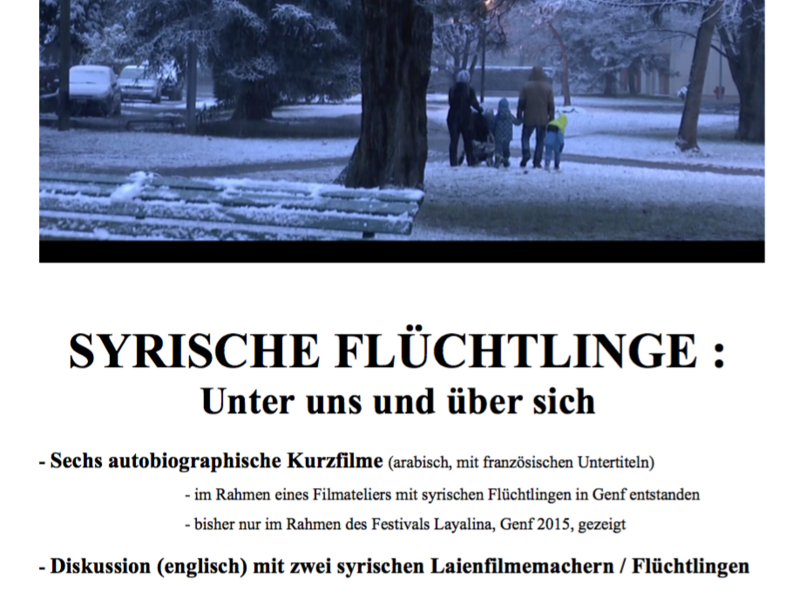
Syrische Flüchtlinge: Unter uns und über sich
Seminar für Nahoststudien der Universität Basel, Maiengasse 51, Raum E 005
Schweizerische Gesellschaft Mittlerer Osten und Islamische Kulturen